
O-1 Visa Agent: How the Filing Process Works
An agent in an O-1 visa isn't some exotic loophole or a gray-area workaround. It's a legally established filing format, used when the standard "one employer, one petition" model doesn't fit.
Under the regulations, an O-1 petition must be filed by a U.S. employer — you cannot file on your own behalf. But the regulations explicitly allow the petition to be filed by a U.S. agent as well — either an individual or a company acting in the capacity of an agent.
Why does this matter in practice?
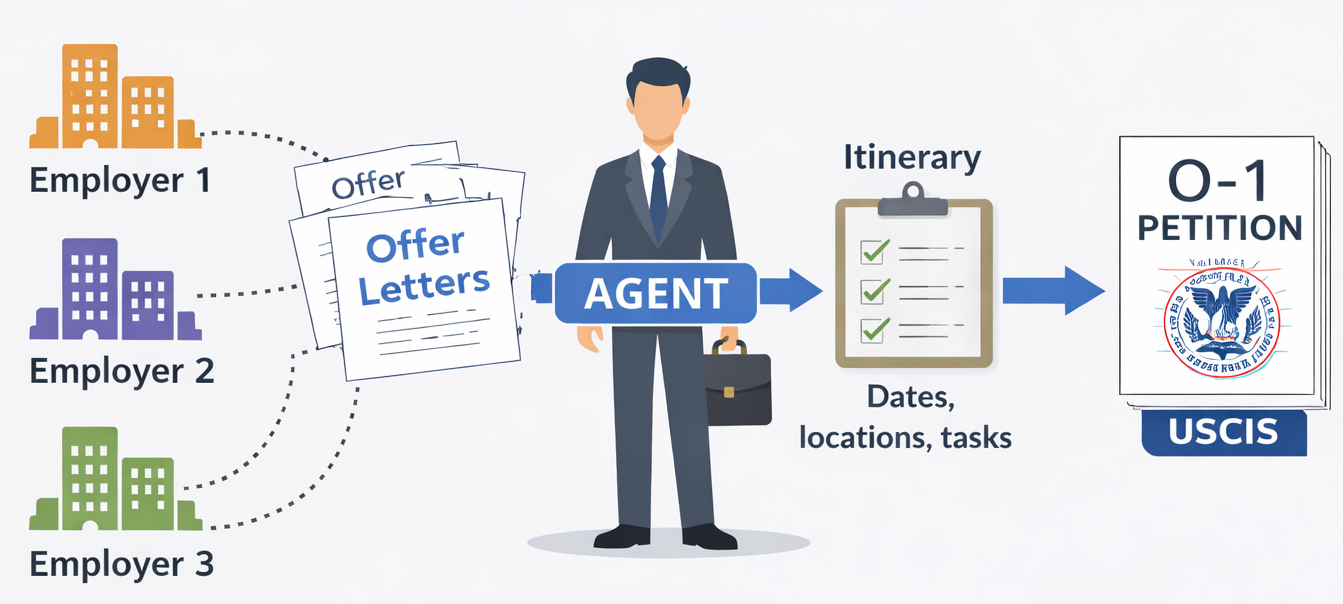
The most common scenario is multiple employers. If a professional works on a project basis and collaborates with several companies at once, without an agent each of those companies would need to file a separate petition. That's inconvenient, expensive, and often simply unrealistic. An agent makes it possible to combine all employers into a single petition. The filing must still include offer letters (letters of intent to engage the beneficiary) from each company, along with a detailed itinerary for each project — dates, locations, and a description of the work involved.
Under the regulations, an O-1 petition must be filed by a U.S. employer — you cannot file on your own behalf. But the regulations explicitly allow the petition to be filed by a U.S. agent as well — either an individual or a company acting in the capacity of an agent.
Why does this matter in practice?
The most common scenario is multiple employers. If a professional works on a project basis and collaborates with several companies at once, without an agent each of those companies would need to file a separate petition. That's inconvenient, expensive, and often simply unrealistic. An agent makes it possible to combine all employers into a single petition. The filing must still include offer letters (letters of intent to engage the beneficiary) from each company, along with a detailed itinerary for each project — dates, locations, and a description of the work involved.
The second common scenario is when an employer doesn't want to deal with immigration paperwork. It's simpler for them to sign a commercial agreement with an agent, who then acts as the petitioner and takes on the work of dealing with USCIS.
The third situation involves a foreign employer. A company based outside the U.S. cannot file an O-1 petition directly. In this case, a U.S. agent is appointed who files Form I-129 and officially represents the employer's interests in the United States.
It's important to understand: an agent is not a "shell" or a pass-through. USCIS scrutinizes whether the arrangement is genuine — looking at the detailed itinerary, the payment terms, and who actually controls and directs the beneficiary's work. If an agent is combining multiple employers, they must be formally authorized to act on each employer's behalf.
Can you set up your own company and file through it? Yes, that's permitted. But the company must be real — with actual business activity, agreements in place, and a clear structure. A formal entity with no real substance behind it raises red flags.
Ultimately, the agent model is a legitimate tool for project-based work, multiple employers, or foreign businesses. It offers flexibility, but it requires careful documentation. When the structure is set up correctly, these cases are approved on a regular basis.
The third situation involves a foreign employer. A company based outside the U.S. cannot file an O-1 petition directly. In this case, a U.S. agent is appointed who files Form I-129 and officially represents the employer's interests in the United States.
It's important to understand: an agent is not a "shell" or a pass-through. USCIS scrutinizes whether the arrangement is genuine — looking at the detailed itinerary, the payment terms, and who actually controls and directs the beneficiary's work. If an agent is combining multiple employers, they must be formally authorized to act on each employer's behalf.
Can you set up your own company and file through it? Yes, that's permitted. But the company must be real — with actual business activity, agreements in place, and a clear structure. A formal entity with no real substance behind it raises red flags.
Ultimately, the agent model is a legitimate tool for project-based work, multiple employers, or foreign businesses. It offers flexibility, but it requires careful documentation. When the structure is set up correctly, these cases are approved on a regular basis.